


There is nowhere on Earth quite like Yellowstone National Park. Half the world's active geysers bubble and blast here. Wolves and grizzlies roam open valleys. An ancient supervolcano rumbles beneath your feet. And spanning 2.2 million acres — larger than Rhode Island and Delaware combined — Yellowstone refuses to be done in a single afternoon.
Summer 2026 is shaping up to be a record season for visitation, which means going in with a plan matters more than ever. This guide isn't a checklist of attractions to "check off." It's a practical, experience-first look at how to actually make the most of your time in the world's first national park — whether you're stepping through the gate for the first time or returning for your tenth summer in a row.
Arrive Early, Stay Late, and Skip the Middle of the Day
The single biggest Yellowstone upgrade you can make costs nothing. The National Park Service recommends arriving at a park entrance before 7 a.m. or after noon, and avoiding the most crowded areas between 10 a.m. and 4 p.m. Those hours are when congestion peaks at Old Faithful, Grand Prismatic, and the visitor centers.
The payoff for early risers is real: golden light on the thermal basins, far fewer cars on the road, and wildlife that is simply more active at dawn and dusk. If you're staying nearby in Big Sky, Montana — just about 50 scenic minutes from the West Entrance — an early start is completely doable. Tuesdays and Wednesdays also tend to be the park's least crowded weekdays if you have flexibility in your schedule.
The Geothermal World Is So Much Bigger Than One Spring
Yes, the Grand Prismatic Spring is extraordinary — its vivid rings of color, visible best from the overlook trail, are unlike anything in North America. But Yellowstone is home to more than 10,000 hydrothermal features, including more than 500 geysers. That's roughly half of all the active geysers on the planet.
Rather than making a beeline for the famous stops and moving on, slow down and explore the full range:
-
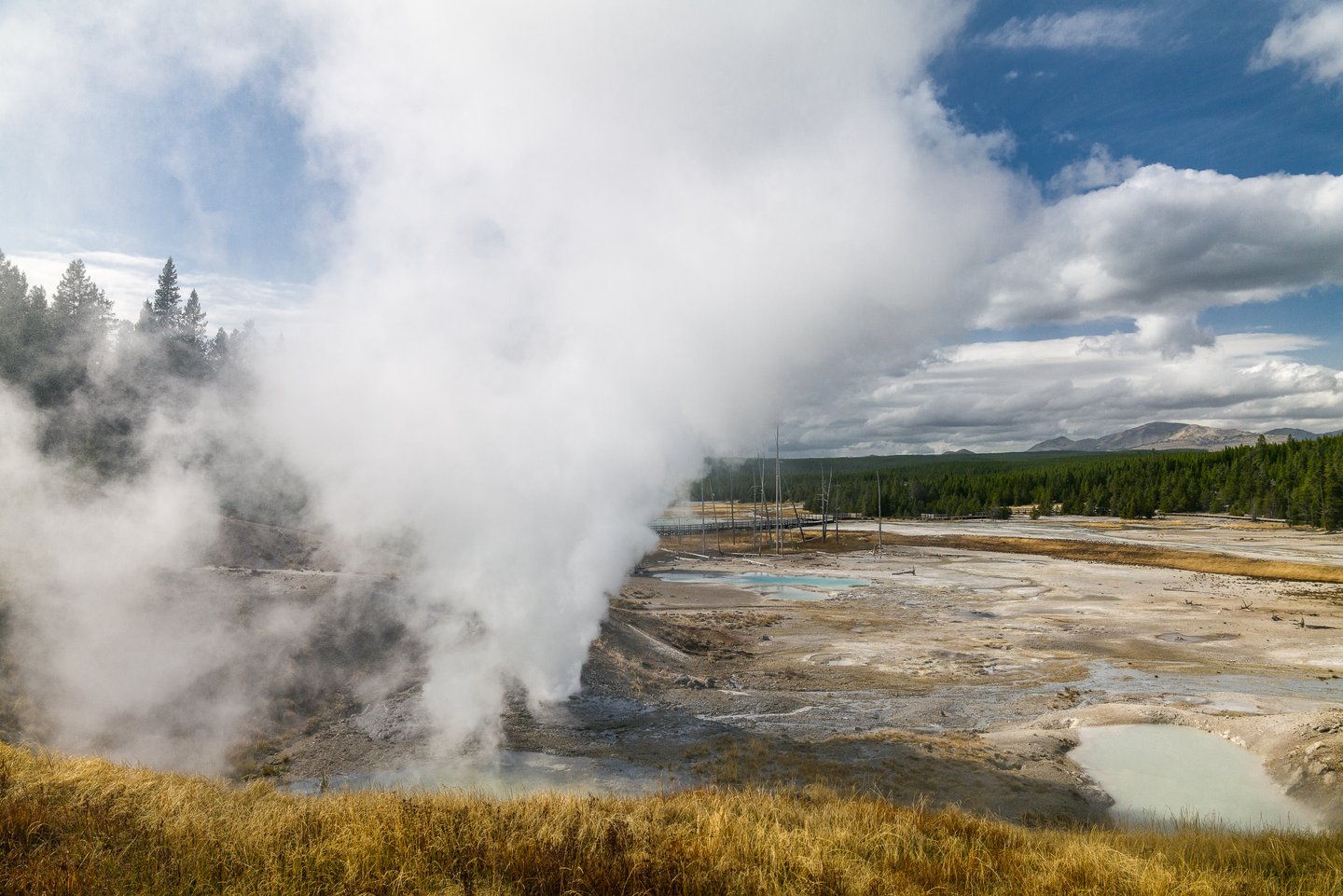
Norris Geyser Basin is the hottest and most dynamic thermal basin in the park — constantly changing, with features that flare to life unpredictably. It's also significantly less crowded than the Old Faithful area in the afternoon.
-
Mammoth Hot Springs looks like something from another planet: tiered travertine terraces that shift and reshape themselves over time, described by early visitors as a "frozen waterfall" in reverse.
-
Midway Geyser Basin is where you'll find Grand Prismatic, but the short boardwalk loop also passes Excelsior Geyser Crater and gives you scale that photos rarely capture — the springs here are the size of football fields.
-
Old Faithful still earns every bit of its reputation. Erupting roughly 20 times a day and shooting 100 to 180 feet into the air, it's one of the few geysers in the world that rangers can reliably predict. Arrive 30 minutes early for a good viewing spot.
Always stay on boardwalks and designated paths in thermal areas. People have been severely burned — and killed — by breaking through the thin crust near features. The ground can be dangerously unstable even inches off the trail.
Wildlife Viewing Is a Skill Worth Developing
Yellowstone has one of the most intact large-mammal ecosystems in North America, and summer is when the park teems with life. But the difference between a great wildlife experience and a frustrating one often comes down to where you go and when.
Lamar Valley — nicknamed "America's Serengeti" — is the crown jewel for wildlife watching. Herds of bison, pronghorn, elk, coyotes, grizzly bears, black bears, and the park's iconic wolf packs all move through this wide, open valley in the park's northeast corner. Dawn is the single best time to be here: quieter, cooler, and dramatically more active than midday.
Hayden Valley, in the park's interior, offers similarly wide sightlines for bison and is one of the better spots to watch for wolves from the road. Bring binoculars or a spotting scope — wildlife watchers stationed along the pull-offs often generously share their scopes with fellow visitors.
A few essentials every visitor should know: - Stay 100 yards from bears and wolves; 25 yards from all other wildlife. These are legal requirements, not just suggestions. - Carry bear spray and know how to use it before you set foot on any trail. - Wildlife jams happen — when a bison or bear stops traffic, pull completely off the road and enjoy the moment from your vehicle.
Hiking: From Accessible Boardwalks to Summit Views
With 92 trailheads and more than 1,000 miles of backcountry trails, Yellowstone rewards anyone willing to walk a little farther than the parking lot.
For high-elevation payoffs, Mount Washburn is one of the park's most popular summit hikes — a 6-mile round trip with sweeping 360-degree views of the Yellowstone Caldera, the Grand Canyon of the Yellowstone, and on clear days, the Teton Range to the south. Bighorn sheep are regularly spotted along the upper ridge. Avalanche Peak, near the East Entrance, is steeper and shorter but delivers similarly jaw-dropping views over Yellowstone Lake.
For something more accessible, the Fairy Falls Trail (3.4 miles round trip) leads to one of the park's most beautiful 200-foot waterfalls, with an optional side trip to an overlook above Grand Prismatic Spring — the bird's-eye perspective that makes those aerial photos possible.
The Grand Canyon of the Yellowstone deserves more than a quick look from Artist Point. Walk the North Rim trail to Inspiration Point, peer into the 1,000-foot-deep gorge painted in amber and rust, and listen for the roar of the Lower Falls — at 308 feet, nearly twice the height of Niagara.
Cast a Line in One of America's Greatest Fisheries
Yellowstone holds more than 200 fishable streams and 45 fishable lakes. The rivers alone — the Madison, Yellowstone, Lamar, Firehole, Gibbon, and Soda Butte Creek, among many others — represent a lifetime of fly fishing. The park's native Yellowstone cutthroat trout are considered one of the most prized catches in freshwater angling.
Summer is prime time. July and August bring peak insect hatches — Pale Morning Duns, Green and Gray Drakes, caddis, and hopper patterns — and nearly all park waters are open. The Lamar River and Soda Butte Creek are particular favorites among guides for their scenic meadow settings and healthy cutthroat populations. The Firehole River offers a uniquely Yellowstone experience: fishing alongside active thermal features.
A few things to know before you wet a line: a Wyoming state fishing license is required (available online or at the park), and some park waters have special regulations. Pick up a current regulations brochure at any entrance station or visitor center, and never — ever — fish without bear spray.
Get Out on Yellowstone Lake
Yellowstone Lake is the largest high-elevation lake in North America at 136 square miles. Most visitors glance at it from the road. The ones who get out on the water remember it forever.
Bridge Bay Marina offers guided fishing and sightseeing charter boats, scenic cruises, dock slip rentals, and backcountry shuttle boat service through mid-September 2026. The lake's cold, clear water and the ring of mountains beyond it create a perspective of the park that's simply impossible to get anywhere else. Kayakers and canoeists can also explore the shoreline, though Yellowstone Lake's weather turns fast — afternoon winds can be significant, and the water temperature is cold enough to cause hypothermia quickly. Check conditions before you head out.
Saddle Up or Hop on a Bike
Horseback riding at the Tower-Roosevelt area is one of the most classic Yellowstone experiences, and one that most visitors skip entirely. Guided one-hour and two-hour trail rides run through late summer from the Roosevelt Lodge corral — and the Old West Dinner Cookout, a ride-in meal in a mountain meadow, is as memorable as any experience in the park.
For cyclists, the Old Gardiner Road is a five-mile unpaved route between the North Entrance and Mammoth that is closed to motor vehicles — meaning it's just you, the sagebrush, and the pronghorn. The Blacktail Plateau Drive is another one-way unpaved road loop excellent for spotting wildlife away from the crowds.
Go to a Ranger Program (Really)
This might be the most underrated thing in the park. Yellowstone's ranger programs are free, run all summer long, and cover everything from geyser geology to wolf pack behavior to the park's Indigenous history. The 2026 summer schedule includes daily programs at Old Faithful, Canyon Village, Mammoth, Fishing Bridge, and Tower-Roosevelt — from 30-minute "Flat Hat Chats" outside the visitor center to two-hour guided hikes.
Kids can earn a Junior Ranger badge by completing an activity booklet available at any visitor center. National Park Week runs August 22–30, 2026, with free entrance for US citizens and residents on August 25 — the NPS's 110th birthday. It's a great window to visit if your dates are flexible.
What to Know Before You Go
Yellowstone is expecting record visitation this summer. Going in prepared makes all the difference:
-
Entrance fee: $35 per vehicle for a 7-day pass; $20 per person on foot or bike; $30 per motorcycle. The America the Beautiful Annual Pass ($80) covers entry to all federal recreation sites for a year and pays for itself fast.
-
No timed-entry reservation is currently required to enter Yellowstone — but book lodging and campsites as far in advance as possible. Sites inside the park fill months out.
-
Cell service is limited or nonexistent across most of the park. Download the free NPS app with offline content before you arrive.
-
Pack for all seasons: summer days can reach the 80s; nights near freezing. Afternoon thunderstorms are common. Layers and rain gear are non-negotiable.
-
Bear spray is essential on any trail. Rentals are available at the Bear Spray Rental Yurt near Old Faithful.
Make Big Sky Part of Your Yellowstone Itinerary
After all of this, you'll want a comfortable place to land. Big Sky, Montana sits just about 50 scenic miles from Yellowstone's West Entrance — close enough for an early morning or evening entry, yet far enough to feel like a genuine mountain town retreat. It's an easy drive from Bozeman Yellowstone International Airport, and the roads between here and the park are some of the most scenic in the American West.
Explore Yellowstone once, and you'll understand why so many people make it an annual pilgrimage. There's truly nothing like it anywhere in the world — and every visit reveals something new. The key is going in curious, going in prepared, and giving yourself permission to slow down.